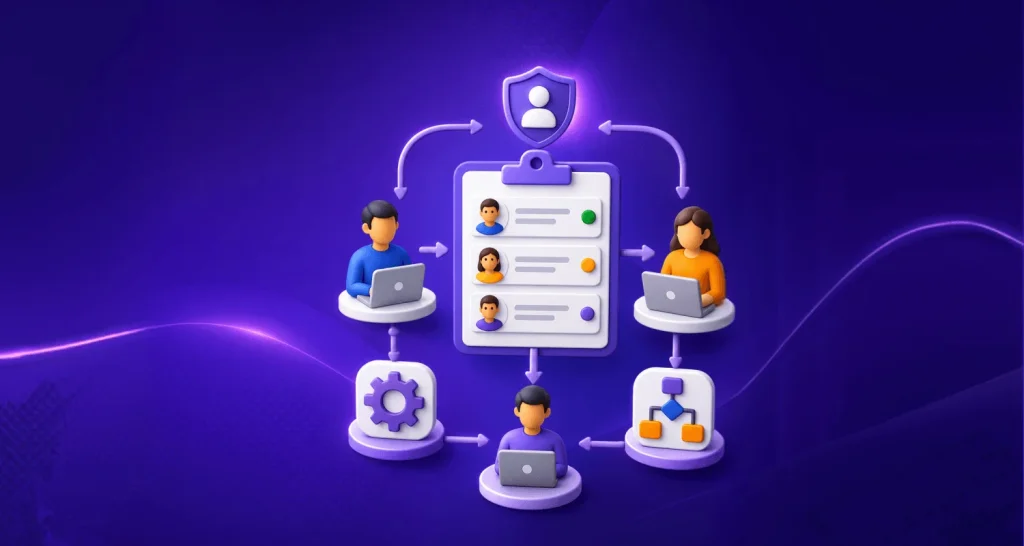



TL;DR: Agentic AI redefines customer experience by enabling customer support systems to understand intent, decide next steps, and take action with guardrails. It helps organizations reduce customer effort, improve consistency, scale support efficiently, and deliver faster solutions across the entire customer journey.
Customer expectations have changed dramatically. Users now expect fast, personalized, and consistent support across every touchpoint, from onboarding to issue resolution.
Traditional rule-based automation often struggles to deliver this level of reliability at scale.
Agentic AI in customer experience represents a fundamental shift by moving beyond reactive responses to intelligent decision-making and action.
This evolution enables organizations to move from fragmented, reactive support to proactive, intelligent, and self‑resolving customer experiences across the entire journey.
In this blog, we explore what agentic AI is, how it works, its impact on customer experience, key challenges, and what it means for the future of modern support.
What is agentic AI?
Agentic AI is an AI system that can understand context, make decisions, and take actions to achieve specific goals within defined guardrails.
In customer experience, those actions may include retrieving order details, updating customer records, scheduling appointments, or processing eligible requests.
The key difference is the degree of autonomy. Some AI systems only recommend actions, while others can execute them with varying levels of human oversight.
Explore our AI agents in customer service guide to learn more about how these systems work.
How autonomy shapes agentic AI in customer experience
Agentic AI can operate with different levels of independence depending on the task, risk, and required human oversight. In customer experience, this can range from assisting agents with information to completing approved workflows within defined boundaries.
For a detailed framework covering assisted AI, advisory AI, human-approved execution, bounded autonomous AI, and self-directed autonomy, see our guide to AI agent autonomy levels.
How agentic AI delivers better support experiences
Agentic AI improves support experiences by understanding customer needs, making decisions, and taking intelligent actions across connected systems.
Instead of only generating replies, it follows a structured decision-making flow to resolve issues faster, maintain consistency, and deliver more efficient experiences.
Here’s how it works:
- Interprets customer intent and context: Agentic AI uses large language models (LLMs), natural language understanding (NLU), and sentiment analysis to understand requests across channels such as live chat and email, factoring in urgency and interaction history.
- Determines the best course of action: Evaluates customer history, business rules, service policies, SLAs, and past outcomes to select the most appropriate next step, whether self-service, escalation, or automated resolution.
- Executes actions intelligently across systems: Once a decision is made, agentic AI can act directly by integrating with tools like help desks, CRMs, and billing systems to complete tasks such as updating accounts, issuing refunds, or triggering customer follow-ups without manual handoffs.
- Reviews outcomes to improve future performance: The system logs outcomes such as resolution success, escalations, failures, and customer feedback. Administrators can use these findings to update their knowledge, instructions, permissions, and workflows.
Use case example
If a customer complains about a late delivery, agentic AI can check the shipping status, notify the customer, verify compensation eligibility, and initiate approved credits or reshipments within predefined limits.
Where agentic AI improves the customer experience lifecycle
Agentic AI delivers value across the customer lifecycle by making decisions at key interaction stages.
This impact spans multiple stages of the customer experience lifecycle, including:
- Onboarding: Provides contextual guidance and proactive assistance to help customers adopt products more smoothly and complete setup with less friction.
- Engagement: Personalizes interactions across channels using context from CRM data, product usage, and past interactions to guide next‑best actions through AI for customer engagement initiatives.
- Support and resolution: Enables faster issue resolution by coordinating workflows across customer support systems when appropriate.
- Post‑resolution learning: Uses outcomes such as resolution success and customer feedback to continuously improve future interactions and reduce repeat issues.
Agentic AI vs generative AI assistants and rule-based chatbots
Agentic AI, generative AI, and chatbots serve different roles in customer experience, based on how they respond, generate, or take action.
While generative AI creates content and chatbots handle conversations, agentic AI goes further by planning and executing tasks across systems to achieve outcomes.
The table below summarizes the key differences between the three aspects of AI.
| Aspect | Rule-based chatbot | Generative AI assistant | Agentic AI system |
| Primary role | Answer predefined questions and guide users through workflows | Generate conversational responses and content | Achieve goals by making decisions and taking actions |
| Typical behavior | Follows predefined rules and conversation paths | Generates responses based on prompts and context | Plans, decides, and executes tasks to complete an objective |
| Autonomy level | Low | Usually low unless connected to tools and workflows | Variable, from recommendation-only to bounded autonomous action |
| Execution | Limited to predefined actions and workflows | May assist with actions when integrated with tools, but primarily generates outputs | Performs actions across connected systems and workflows |
| Context handling | Limited conversation and workflow context | Understands conversational context and intent | Maintains context across tasks, decisions, and multistep workflows |
| Decision-making | Follows predefined rules | Generates recommendations and responses | Evaluates options, makes decisions, and selects actions |
| Goal orientation | Completes predefined interaction paths | Responds to prompts and requests | Works toward a defined business or customer outcome |
| Customer outcome focus | Provides information or guidance | Provides information or drafts content | Can resolve supported issues by completing approved tasks and workflows |
| Human oversight | Defined during setup and workflow design | Usually reviewed through prompts, policies, or approvals | Governed through approvals, permissions, and monitoring |
These categories can overlap. A chatbot may use generative AI, and a generative AI assistant may access tools.
Agentic AI is distinguished by its ability to select and execute actions toward a defined outcome. Learn more in our detailed AI agent vs chatbot comparison.
Real-world applications of agentic AI in customer experience (CX)
Agentic AI is becoming increasingly important as organizations expand the role of AI in customer support.
Salesforce’s 2025 survey found that teams estimated AI was already handling 30% of service cases and expected that figure to reach 50% by 2027.
This shift is accelerating demand for AI that can not only respond but also take action, as shown in the following examples
- Order support: Retrieve order information, detect delivery problems, and initiate approved resolution workflows.
- Account servicing: Update eligible customer information or complete approved account changes.
- Billing support: Investigate charges and initiate refunds or credits within defined policies.
- Proactive support: Identify potential issues and initiate assistance before a customer contacts support.
- Cross-system resolution: Coordinate tasks across help desks, CRMs, billing systems, and other connected tools.
You can explore more in our guide on AI agent examples across customer service workflows.
How to deploy agentic AI responsibly in customer experience
Responsible deployment requires clear boundaries around what AI can do, when humans should intervene, and how customer-impacting actions are monitored.
Organizations should establish safeguards that balance efficiency with customer trust, operational control, and compliance requirements. These safeguards include:
- Defining which customer interactions AI can handle independently.
- Requiring human review for sensitive or high-impact actions.
- Restricting access to customer data and connected systems based on business needs.
- Establishing escalation and fallback procedures when requests cannot be resolved automatically.
- Monitoring accuracy, failed actions, escalations, and customer outcomes to identify improvement opportunities.
- Maintaining audit trails and human override mechanisms to support accountability and oversight.
Responsibility remains with the organization deploying the system. While agentic AI can help automate customer interactions and complete approved actions, businesses are responsible for defining policies, monitoring performance, addressing failures, and ensuring that AI operates within established guardrails.
Challenges of agentic AI in customer experience
While agentic AI offers significant potential for customer experience strategies, it also introduces drawbacks that organizations must address to maintain trust, consistency, and control.
Understanding the challenges and how to mitigate them is essential for deploying agentic AI responsibly across customer touchpoints.
Below are key challenges associated with agentic AI and recommended approaches to address them.
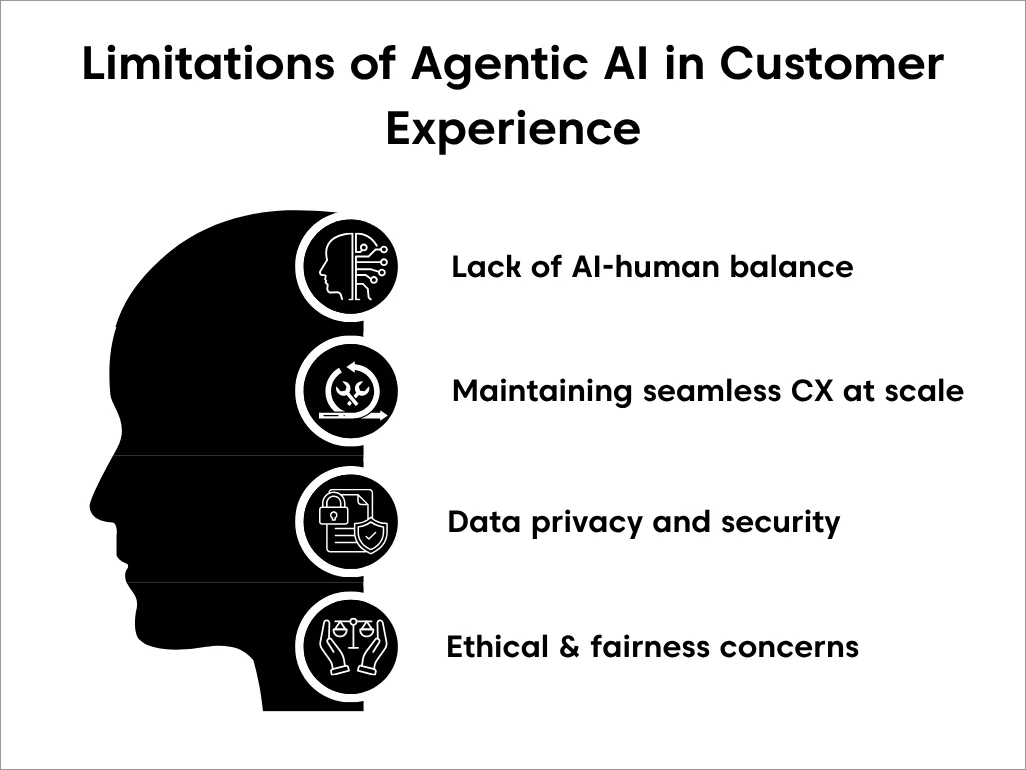
Lack of human-AI balance
When agentic AI operates without sufficient oversight, it can disrupt the balance between human judgment and machine decision‑making.
This can lead to over-reliance, reduced accountability, and misaligned goals.
Maintaining a clear path to human assistance is critical, as a 2026 Gartner survey found that 87% of customers believe companies using generative AI for customer service should provide access to a human agent.
Solution
Maintain live agents in the loop by defining clear boundaries for AI, implementing transparent decision logic, and aligning AI behavior with organizational values.
This ensures agentic AI supports human decision‑making rather than replacing it.
Difficulty maintaining a seamless CX at scale
As agentic AI systems scale across channels and use cases, ensuring every interaction remains accurate, timely, and aligned with brand standards becomes increasingly complex.
Solution
- Use a centralized experience layer with real‑time monitoring, cross‑channel synchronization, and contextual memory.
- Integrate contextual memory, human oversight, and governance frameworks to help maintain consistency and trust across customer interactions.
Data privacy and security risks
Agentic AI often accesses and processes sensitive customer data, increasing the risk of data exposure, misuse, or compliance violations if not properly controlled.
Solution
- Design systems with privacy‑by‑design principles.
- Comply with regulations such as GDPR, CCPA, and HIPAA.
- Apply strong encryption, access controls, audit trails, and role‑based permissions.
Ethical and fairness concerns
Without proper safeguards, agentic AI can reinforce bias, operate without transparency, or handle sensitive data inappropriately, leading to customer distrust and legal risk.
Solution
- Implement a robust AI governance framework that includes bias testing, explainability mechanisms, and ethical guidelines.
- Oversight by dedicated review teams to ensure fairness, accountability, and transparency.
Reshaping the future of CX with agentic AI
As customer expectations continue to evolve, agentic AI represents a foundational shift in how organizations design, deliver, and scale meaningful customer experiences.
When implemented with clear guardrails, it changes how customer support operates, enabling systems to act with greater speed, consistency, and focus while allowing agents to concentrate on complex, high‑empathy cases.
Platforms like BoldDesk are designed to support this shift through intelligent automation that streamlines repetitive work while helping teams monitor outcomes and refine workflows over time.
Ready to upgrade your customer experience? Start a free trial to explore how agentic AI can fit into your support workflows.
Have questions or insights about implementing agentic AI in customer experience? Leave a comment below and join the discussion.
Related articles
- What Is Conversational AI for Customer Service? Use Cases and Benefits
- What are Autonomous Agents in Customer Support? | BoldDesk
- Future of Customer Service: Top Trends for Businesses in 2026
FAQs about agentic AI in customer experience
When an agentic AI action cannot be completed, the system should stop the workflow, log the failure, explain the issue, and either retry the task or escalate it to a human agent based on predefined rules.
Common causes include missing information, permission restrictions, policy conflicts, or system outages, making clear fallback processes, audit trails, and human oversight essential for maintaining accuracy, accountability, and a positive customer experience.
High-risk tasks such as high-value refunds, account ownership changes, sensitive data updates, compliance decisions, and legal complaints should not be fully autonomous.
These actions typically require human review because mistakes can have financial, security, or regulatory consequences.
Businesses should track metrics such as resolution rate, resolution time, customer satisfaction (CSAT), escalation rate, task accuracy, and policy compliance.
Monitoring both customer outcomes and governance metrics helps ensure the AI is effective, reliable, and accountable.
An AI agent makes decisions and takes actions to achieve a goal, while an agentic workflow defines the steps, rules, approvals, and systems involved in completing a task.
In short, the agent decides what to do, and the workflow governs how it is done.
Agentic AI systems are trained using historical customer interactions, knowledge base content, and real-time feedback to improve accuracy, relevance, and customer satisfaction over time.
Instead of just responding to queries, they can perform actions such as resolving tickets, suggesting next steps, or personalizing responses based on approved workflows, permissions, and business rules.
If you’re evaluating agentic AI, prioritize tools that support controlled actions, approvals, audit logs, and clear human handoff for higher-risk cases.